Exxon Mobil’s Dividend Resilience Amid Earnings Decline
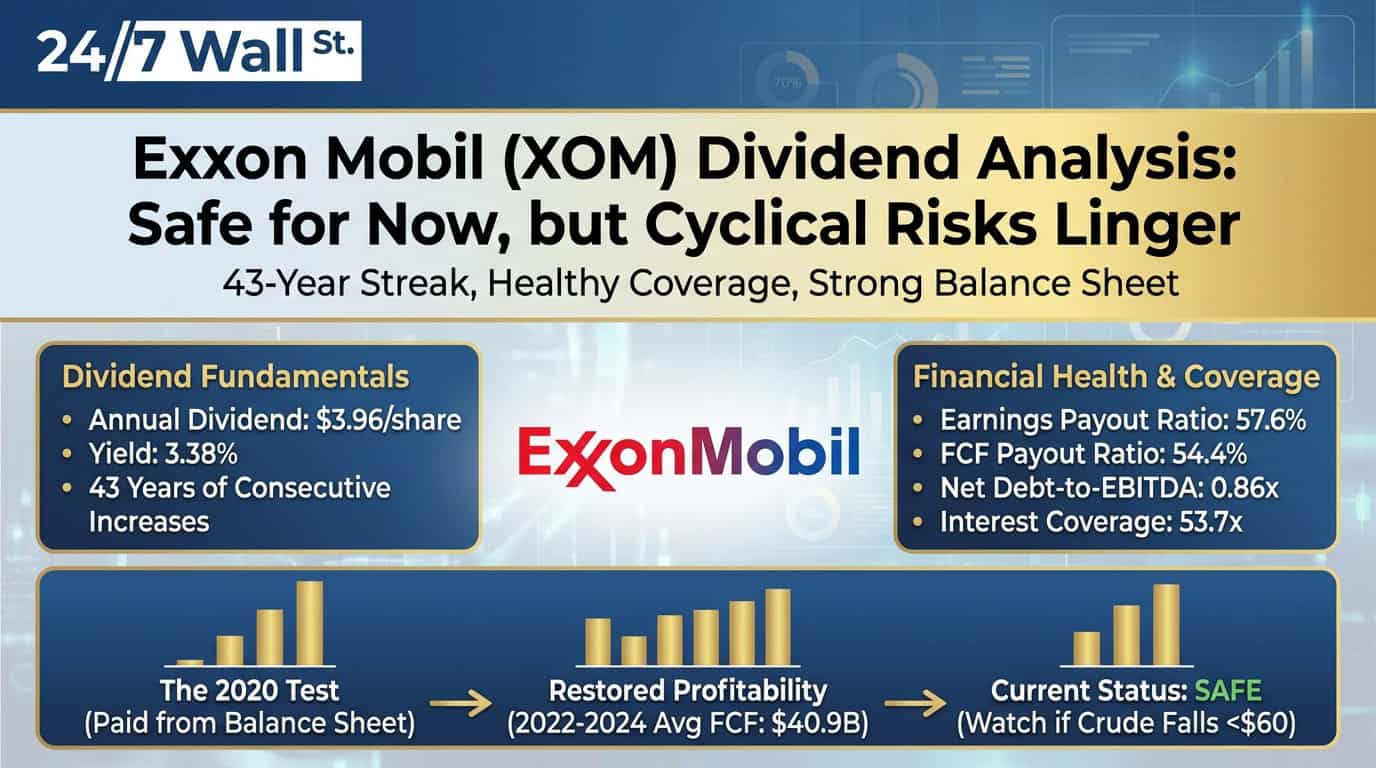
Exxon Mobil (XOM) remains a steadfast contender in the dividend landscape, currently doling out an annual dividend of $3.96 per share with a yield of 3.38%. This remarkable consistency is underscored by an astonishing record of increasing its dividend for an uninterrupted 43 years, a streak that persists even through the unprecedented downturn experienced during the oil price collapse of 2020.
Analyzing the Payout Ratios
To gauge the sustainability of this dividend amid falling earnings, one must scrutinize its payout ratios which currently sit at a comfortable 57.6% based on earnings, deriving from a trailing twelve-month (TTM) diluted earnings per share of $6.88. Such a ratio indicates a significant buffer, safeguarding the dividend from potential cuts should earnings continue on a downward trend.
Further examination of the free cash flow (FCF) reveals an equally effective ratio of 54.4%. In 2024, Exxon managed to generate $30.7 billion in free cash flow—derived from operating cash flow of $55 billion while accounting for capital expenditures of $24.3 billion—against its $16.7 billion dividend obligations. This lends credibility to the current assessment that Exxon’s distribution strategy is solidly supported, at least for now.
Profitability and Financial Health
However, there is a notable concern; net income has plummeted from a staggering $55.7 billion in 2022 to just $33.7 billion by 2024, evidenced by a 12.3% year-over-year decline in Q3 earnings. Such reductions could pressure dividend sustainability if the trend persists.
Exxon’s balance sheet emerges as a fortress against these tumultuous fluctuations, boasting a net debt of $53.3 billion against an EBITDA of $61.7 billion, resulting in a favorable net debt-to-EBITDA ratio of 0.86x. Additionally, the company enjoys robust interest coverage at a staggering 53.7x, effectively cushioning its operations against potential financial strains.
The 2020 Test and Future Outlook
The true test of Exxon’s dividend commitment came during the chaotic financial upheaval of 2020, when the company reported a crippling loss of $22.4 billion yet still maintained its dividend obligations by leveraging its healthy balance sheet. Following that debacle, Exxon recompensed by restoring profitability, demonstrating significant cash flow generation and thereby easing fears surrounding its dividend safety greatly.
Looking ahead, the dividend appears secure based on current payout structures, assuming oil prices maintain above $70 per barrel and that Exxon persists in its capital discipline. Conversely, should crude prices dip below the detrimental $60 mark, the implications for both earnings and cash flow might jeopardize future dividend increases, though likely not the dividend’s very existence itself given its substantial balance sheet strength.
Conclusion on Dividend Viability
Ultimately, Exxon Mobil’s dividend is currently rated as safe. However, investors should maintain vigilance concerning fluctuations in oil costs and overall market dynamics, as these external factors could materially impact the company’s financial health and, subsequently, its distributions to shareholders.
Reflecting on Retirement Strategies
For those contemplating retirement, investment strategies often position dividends as an essential component of portfolio management. Understanding the dynamics of income generation versus wealth accumulation could facilitate a more informed approach, leading many to discover that earlier retirement might indeed be within reach.
Source: finance.yahoo.com/news/exxon-mobil-43-dividend-streak-163703656.html