Quantum Computing: The Overhyped Mirage
Quantum computing, a realm filled with endless promises and staggering potential, is often hailed as the future of computing innovation. Companies like IonQ are touted as forerunners in this technology. Yet, behind the dazzling headlines and inflated valuations lies an industry riddled with unanswered questions and unexplained risks. The entire concept is appealing—a technology that could theoretically outpace classical supercomputing by centuries in solving particular problems. But reality often slams the brakes on such unchecked enthusiasm.
Understanding how quantum computers function at their core should make anyone pause. By leveraging quantum superposition and entanglement, these machines aim to perform calculations that are unimaginable for traditional computers. However, the supposed efficiency has yet to translate into anything beyond theoretical frameworks or sparse real-world applications. Investors and technophiles alike might be blinded by the gleam of this potential, but where’s the proof of its capability? As of now, the technology remains a black hole consuming research dollars without producing tangible breakthroughs that justify its hype.
IonQ: A Cash-Burning Experiment
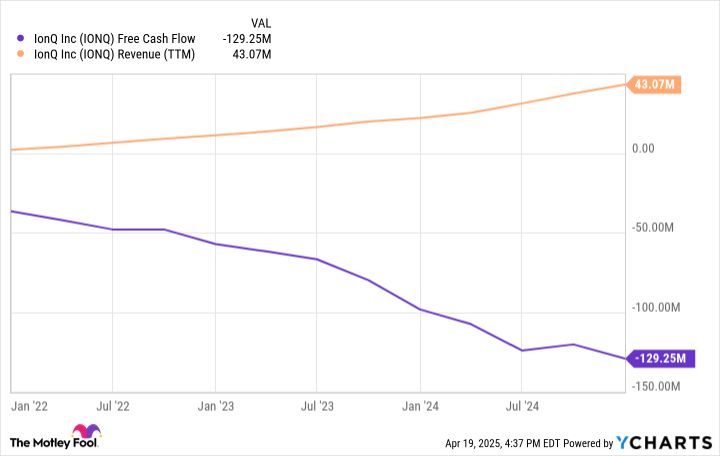
If anything embodies the speculative bubble of quantum computing, it is IonQ. Here is a company burning through $129 million annually in free cash flow, barely scraping $50 million in annual revenue. Despite possessing $364 million in cash reserves, simple math suggests that IonQ has less than three years before it hits the fiscal wall unless it starts generating results. Let that sink in—three years. Meanwhile, its cohort of rivals, including juggernauts like Microsoft and Alphabet, continue to outpace it in terms of resources and technological maturity.
Why prop up a company that hasn’t turned a profit and competes in a playing field dominated by elite tech giants? Those claiming that IonQ is leading a “revolution” in computing are either woefully naïve or willfully misleading. The stark absurdity of valuing this company at $6 billion while it hemorrhages funds should raise red flags. Even the most optimistic projections suggest that quantum computers won’t reach large-scale commercialization for at least another decade. This is speculative investing at its worst, a science project masquerading as a transformative business.
The Mirage of Commercial Application
Let’s dispel another myth: quantum computing isn’t here to replace your smartphone or transform your everyday tech experience. It is built for highly specialized problems, most of which aren’t even suitable for quantum solutions at the moment. Areas like drug development, chemical compound optimization, and AI advancements are frequently touted as ideal applications, but the monumental gap between theory and practice remains unbridged.
IonQ boasts about its first-gen machines being accessible via platforms like Amazon Web Services, a symbolic move rather than a groundbreaking one. Integrating experimental tech into the cloud sounds impressive until you realize that its real-world utility remains virtually non-existent. The narrative of “potential” keeps growing bloated, yet no one seems willing to question the thinness of actual progress.
Big Promises Against Unforgiving Realities
No one should doubt the fascinating possibilities attached to quantum computing. But there’s a fundamental dishonesty in how companies like IonQ position themselves within the marketplace. They dangle visions of unprecedented computing power while offering minimal proof of practical viability. Their pitch exploits a dangerous mix of technical jargon and hype, banking on investor ignorance.
The competitive landscape refuses to play in IonQ’s favor either. With titanic competitors like Alphabet and Microsoft holding significantly larger budgets and established infrastructures, IonQ faces almost insurmountable odds. The need to continuously rake in capital will inevitably dilute existing shareholders’ stakes, compounding the pain for those enticed by the company’s ambitious promises.
The Brutal Reality for Investors
The allure of investing in forward-facing technologies has trapped even the savviest investors at times. Companies like Nvidia have proven that calculated risks in emerging sectors can yield astronomical returns. But for every Nvidia, there are countless IonQs: speculative ventures that siphon billions before imploding under the weight of unfulfilled fantasies. IonQ’s financial trajectory currently leans toward the latter.
Let the numbers speak. With mounting cash burn and minimal revenue generation, IonQ resembles a ticking time bomb rather than a long-term opportunity. The naïveté—or outright cynicism—required to market this as a profitable or even viable investment is staggering. Investors need to recognize the chasm between ambition and execution that companies in this sector continue to widen.
A Techno-Dream Deferred
The world is littered with technological aspirations that never reached fruition. For the quantum computing hype train, IonQ is rapidly becoming its unfortunate standard-bearer. Its promises of revolutionizing computing could one day come true—but with its dwindling resources and staggering competition, will IonQ even survive long enough to see that day?
This isn’t innovation; it’s indulgence. And as the clocks tick closer to fiscal reality, the company may find itself trapped, a victim of its own overhyped ambitions. Investors and advocates alike would do well to ask: What happens when the glow of quantum computing’s allure no longer shields IonQ from the cold, harsh scrutiny it so desperately deserves?
Source: finance.yahoo.com/news/ionq-stock-buy-134500767.html