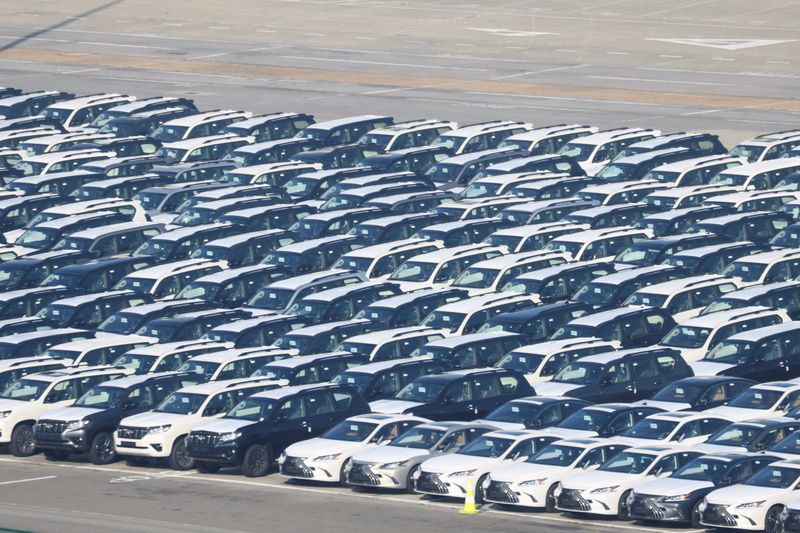
A Savage Blow to European Automakers: Tariffs Strike Hard
The latest American tariffs targeting imports from Mexico have landed like a sledgehammer on European carmakers. A monstrous 25% levy is now in full effect, sending the already fragile automotive market into a downward spiral. This brazen move, a clear attempt to strong-arm economic agreements, has rattled giants like Volkswagen, Stellantis, and BMW, each relying heavily on Mexican production facilities to satiate North American demand. The carnage is laid bare as the STOXX Europe 600 Automobiles and Parts index nosedives by 3.8%. This isn’t just a “bad day at the market”; this is an all-out economic ambush.
Export Giants Cry Foul
Volkswagen and Stellantis, revered as the titans of European exports to North America, find themselves suddenly gasping for air. Years of strategic investments and production scaling in Mexico have now been buried under the rubble of short-sighted trade policies. Meanwhile, automotive supplier Continental sees its shares obliterated by an agonizing 8.4% drop. Continental’s response? Endless “analysis” of what this new hellish reality means for its sites in Mexico. Words from its CEO harp on open trade regimes, but let’s be blunt: Europe’s industrial Achilles’ heel has been exposed for the world to see, and every European policymaker worth their salt knows it.
Germany: The Heart of the Wounded Beast
It’s no secret that Germany’s economy thrives on exports. Their highly engineered, luxury vehicles have long commanded global demand. Yet, the harsh U.S. tariffs have slapped German carmakers with the bitter taste of their reliance on North American trade. Munich’s heads are spinning as criticism mounts against shoving manufacturing capacity toward Mexico in years past. Was it visionary or simply a miscalculated gamble with geopolitics? The chilling silence in Berlin suggests the latter might be closer to the truth.
A War of Words Escalates
In the midst of this diplomatic chaos, Germany’s Economy Minister Robert Habeck erupted with fiery rhetoric. Promising unity and “self-confidence,” Habeck laid down the gauntlet, vowing that Europe “will not be pushed around.” Is this defiance a rallying cry for preservation, or a desperate attempt to mask the vulnerability laid bare by these tariffs? Either way, the tit-for-tat threats between Europe and the U.S. are veering dangerously close to open trade warfare—the economic equivalent of trench warfare with devastating consequences for all involved.
An Industrial Empire Stumbles
The collateral damage doesn’t stop with car manufacturers; it ripples outward like a toxic shockwave. For Europe’s industrial image, this is a moment of reckoning. Years of integrating Mexico into North American supply chains is starting to look alarmingly naive in the face of aggressive American economic nationalism. With shares in chaos and policymakers scrambling to respond, one question emerges: has Europe been outmaneuvered—or outplayed?
This is not innovation; this is survival at its most primal. European carmakers now face a turbulent road ahead, laden with tariffs and trade barriers poised to rip apart years of global strategy. The question isn’t whether they’ll respond but whether they’ll survive on the terms dictated by a trade landscape that just became far more brutal.
Source: finance.yahoo.com/news/european-auto-stocks-plunge-u-094422857.html