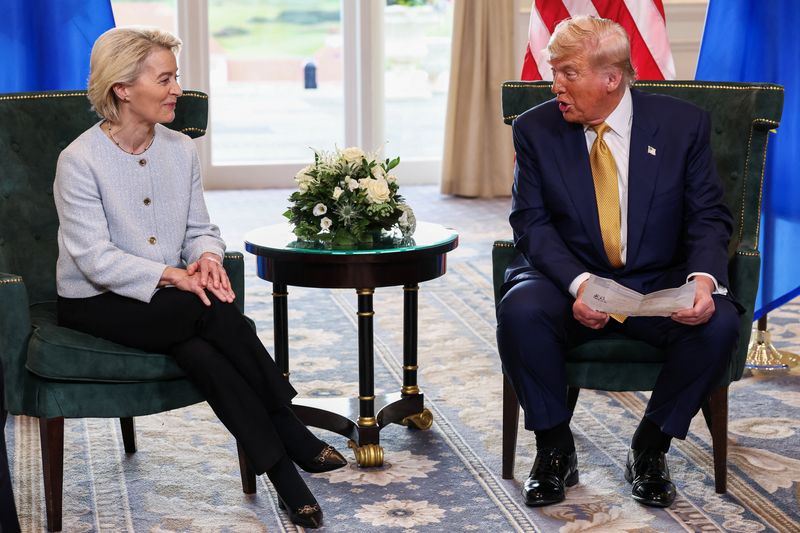
Unraveling Trade Turmoil
In a world increasingly fraught with economic tension, the latest trade agreement between the U.S. and the European Union emerges as a double-edged sword. On the surface, it appears to be a political victory, yet a closer examination reveals an alarming amalgamation of tactics that leaves both nations teetering on the brink of further turmoil.
The Merger of Politics and Economics
President Trump’s recent declaration of a 15% tariff on European goods may resonate as a mere political maneuver, but it belies the deeper implications—a calculated effort to manipulate the economic framework for political gain. The stipulation for the EU to purchase vast quantities of U.S. military and energy supplies poses troubling questions about the true nature of “trade negotiations.”
Market Reactions: Pleasures and Pitfalls
Financial markets, ever the barometers of sentiment, reacted predictably to the news, with several indices soaring. Yet, this exuberance is a superficial mask for an underlying disease—the very same tariffs designed to protect the U.S. industries threaten to distort global trade and consumer prices. As investors cheer short-term profits, they may be opening Pandora’s box of long-term economic repercussions.
Economic Experts Weigh In
Economic analysts, the practitioners of deciphering the complex language of trade, have taken to dissecting the implications of this deal. Kristina Clifton, a senior economist at the Commonwealth Bank of Australia, stripped the narrative down to its raw bones, claiming the agreement is merely a ‘headwind for the global economy.’ The specter of unfulfilled negotiations with other nations looms ominously, threatening to destabilize any semblance of global economic cooperation.
The Notion of Success: A Deceptive Mirage
Critics argue that calling this agreement a ‘win’ is akin to celebrating a hollow achievement. Prashant Newnaha from TD Securities aptly characterized it not as a negotiation, but as an imposition—a one-sided enactment of power rather than collaborative diplomacy. The implications here are profound; the asymmetrical deal sought by Trump becomes a precedent that may embolden future confrontations in the arena of global trade.
Tariff Implications: A Hostage Situation
With tariffs now a blunt instrument of trade policy, the question arises: who truly benefits? The margins of such punitive measures force domestic consumers to bear the burden, as manufacturers may be prone to pass these costs onto the public. Brian Jacobsen from Annex Wealth Management underscores this tension, drawing parallels to a strategy that can stifle growth regardless of initial appearances.
Expectations vs. Reality
Investors, always hungry for insight, are left grappling with the dichotomy of optimism and caution. While immediate gains are celebrated, the reality of prolonged uncertainty and potential inflation overshadows this fleeting joy. Analysts emphasize the importance of the agreement’s details, a minefield of complications that could implode at any moment—much like a ticking time bomb in the world of trade.
Conclusion: A Quagmire Ahead
As we absorb the storm of headlines celebrating this so-called triumph in trade relations, a far grimmer picture unfolds. The complexities and latent dangers pose significant threats not merely to the entities involved but to the global economic landscape at large. Whether bolstered by deceptive cheer or cloaked in uncertainty, the fragility of this agreement demands scrutiny from all economic participants.
Source: finance.yahoo.com/news/reaction-us-eu-trade-deal-181518896.html